
Table of Contents
Essential Masonry Repair Services in San Francisco
San Francisco’s iconic architecture, from fog-eroded Victorian facades to sturdy brick warehouses, demands expert San Francisco Masonry Repair to withstand time and elements. The city’s frequent seismic activity and persistent foggy climate accelerate wear on brick, stone, and concrete structures, leading to cracks and erosion that threaten structural integrity.
Over 60% of San Francisco buildings from the pre-1980s require masonry updates, per regional surveys in the San Francisco Masonry Repair Guide. Water infiltration exacerbates these issues, making timely interventions essential. Integrated waterproofing San Francisco solutions pair with repairs to prevent further damage in this vulnerable environment.
ARC Architectural Restoration Waterproofing, a trusted Bay Area masonry restoration contractor with over 40 years of licensed experience, specializes in masonry restoration tuckpointing, brick tuckpointing San Francisco, concrete reconstruction, and stucco repair for multi-family condos, commercial buildings, and historic properties. Compliant with California building codes, ARC ensures durable, code-approved results.
Explore upcoming sections on local challenges, essential services, and how to get a free estimate for your project.
Masonry Challenges in the San Francisco Bay Area
The San Francisco Bay Area’s unique geography presents significant masonry challenges for multi-family residential and commercial properties. Frequent seismic activity, persistent coastal fog, and aging infrastructure accelerate deterioration, demanding proactive San Francisco Masonry Repair strategies. Specialized contractors like ARC conduct professional leak analysis to diagnose issues early, preventing costly escalations.
Earthquake-induced cracking plagues unreinforced masonry, especially in historic structures prone to Bay Area brick deterioration. Post-1989 Loma Prieta quake, Marina District balcony failures highlighted the urgency of structural repairs seismic retrofit to reinforce vulnerabilities. Meanwhile, fog and rain erode mortar joints, with coastal exposure doubling failure speeds according to local tuckpointing data; this leads to water infiltration and SF stone maintenance needs. Urban pollution in denser areas like the Financial District hastens concrete spalling, requiring concrete wall reconstruction for degraded facades. Hillside properties face slippage risks from soil movement, differing from modern buildings’ engineered resilience.
- Seismic Stresses: Cracks and shifts in brick walls.
- Moisture Intrusion: Fog-driven erosion and leaks.
- Pollution Effects: Accelerated stucco and concrete wear.
- Site-Specific Issues: Slippage in sloped terrains.
The Bay Area’s diverse topography–from coastal zones to urban cores–influences masonry vulnerabilities, shaping repair priorities by neighborhood. The following table outlines these variations:
Neighborhood Masonry Repair Needs Comparison
This table compares common masonry issues and service priorities across key San Francisco Bay Area neighborhoods, helping property owners identify relevant challenges and contractor focuses.
| Neighborhood | Primary Challenges | Common Services Needed | Estimated Repair Frequency |
|---|---|---|---|
| Mission District | Earthquake cracks in brick walls, water infiltration from fog | Tuckpointing, seismic retrofits | Every 5-7 years for historic buildings |
| Financial District | High-rise concrete spalling, urban pollution erosion | Concrete reconstruction, stucco repair | Biennial for commercial facades |
| Pacific Heights | Dry rot in wood-masonry interfaces, hillside slippage | Brick restoration, structural reinforcements | Every 3-5 years due to seismic risks |
| SoMa (South of Market) | Industrial-era stone degradation, vibration from traffic | Stone repair, expansion joint caulking | Annually for high-traffic properties |
| Marina District | Coastal salt damage, balcony masonry failure | Masonry waterproofing, deck restorations | Every 4-6 years for waterfront exposure |
Data sourced from Bay Area building inspections and ARC project logs; frequencies based on 40+ years of regional experience; consult local codes for compliance.
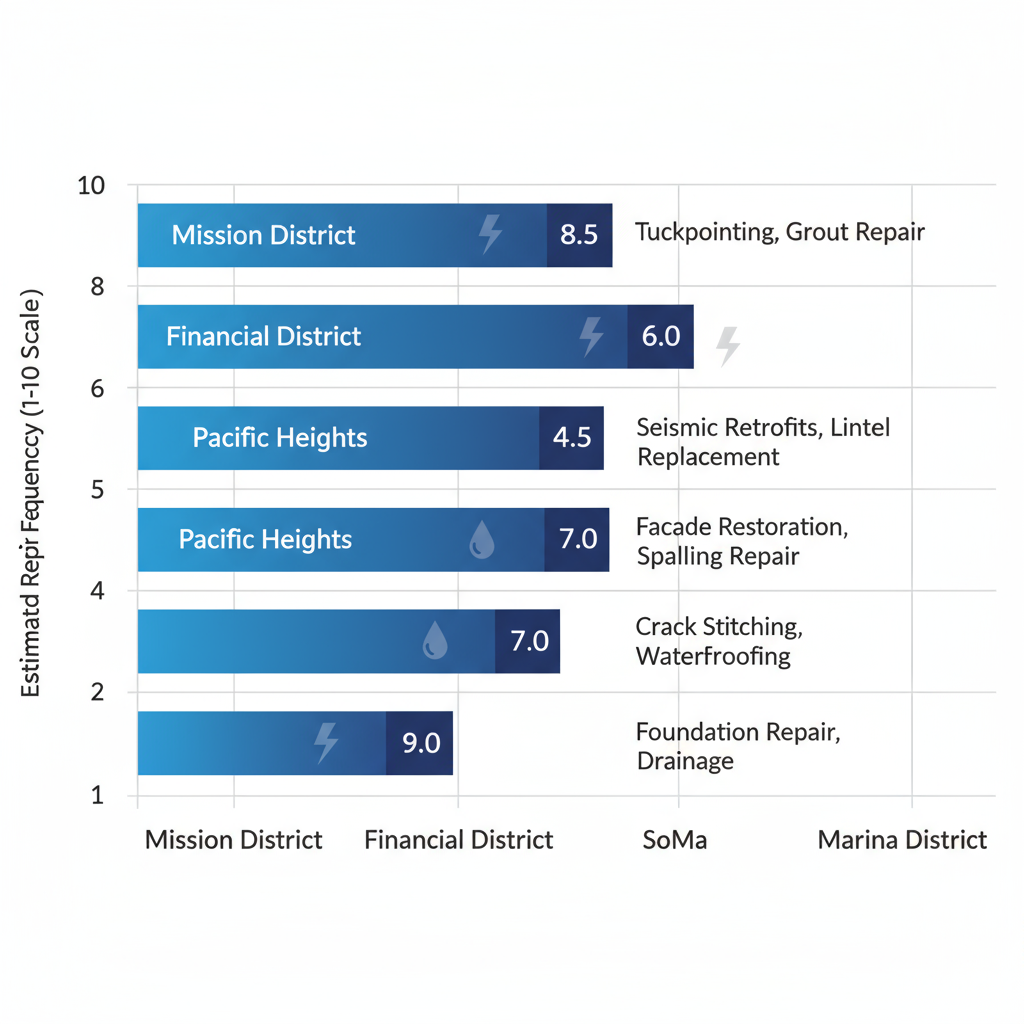
Visualization of Bay Area neighborhood masonry repair needs
Seismic hotspots like Pacific Heights show elevated frequencies, underscoring the value of brick tuckpointing San Francisco for prevention. High-traffic SoMa demands regular caulking expansion joints to combat vibrations. As a trusted masonry restoration contractor bay area, ARC tailors solutions to these patterns, ensuring durable outcomes for historic and modern properties alike.
Masonry Restoration Options in the Bay Area
In the Bay Area, masonry restoration addresses the region’s seismic activity, fog, and salt exposure that degrade building facades. Masonry restoration contractor bay area like ARC provide comprehensive services for residential multi-family units and commercial structures, from initial diagnosis to durable execution. This integrated approach ensures code-compliant repairs that preserve historic integrity while enhancing longevity, tailored to San Francisco’s unique environmental challenges.
Brick Tuckpointing Processes
- Remove deteriorated mortar and match new to original color and composition for seamless integration.
- Apply joint sealing to prevent water intrusion, a critical step in humid climates.
According to the San Francisco Masonry Repair Guide, brick tuckpointing San Francisco extends masonry life by 25 years. For instance, restoring a Noe Valley condo facade involves precise brick tuckpointing San Francisco to revive weathered exteriors without altering architectural charm.
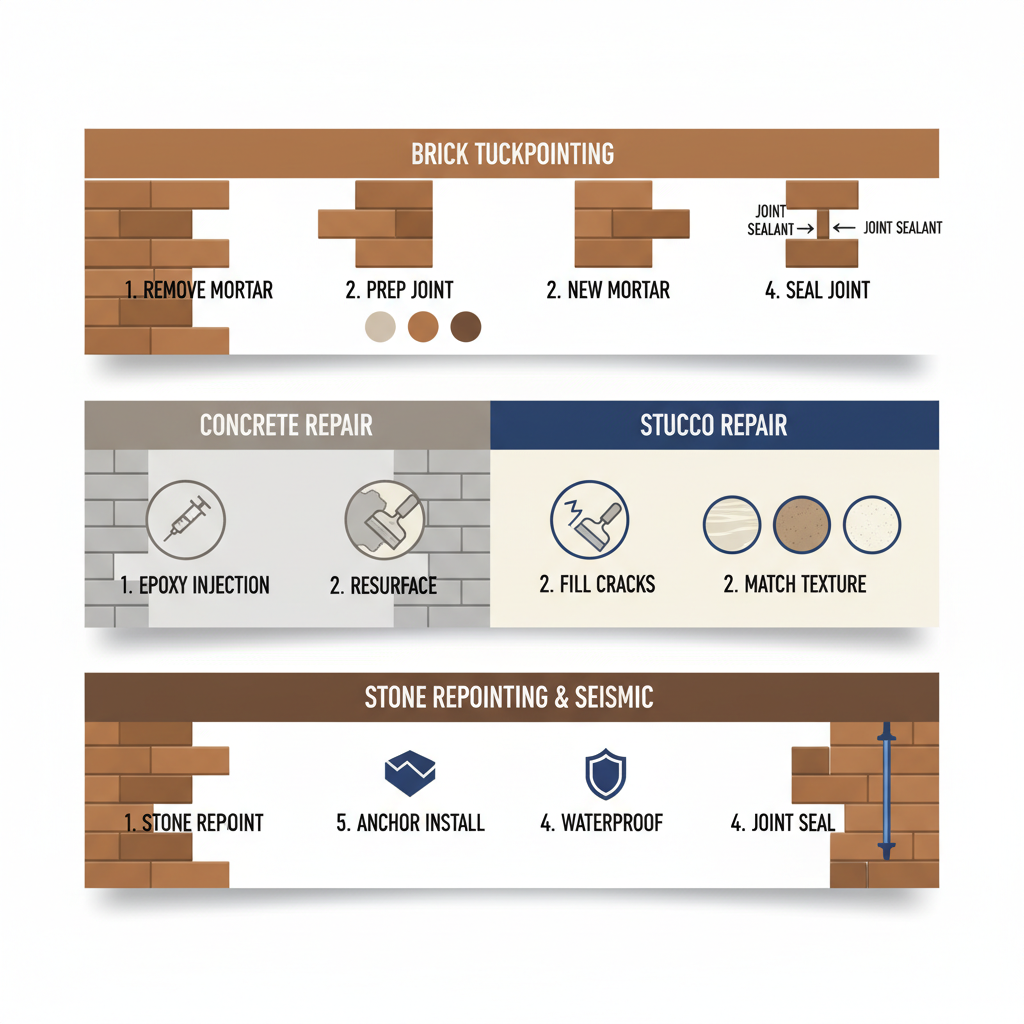
Masonry restoration techniques for Bay Area properties illustrated in four connected panels
Concrete and Stucco Repairs
- Concrete reconstruction uses epoxy injection to fill cracks and resurfacing for smooth finishes, ideal for load-bearing walls.
- Stucco and EIFS wall repairs focus on crack filling and texture restoration via stucco concrete repair, addressing moisture damage in multi-family buildings.
These methods differ from basic repairs by rebuilding structural integrity, answering queries on handling diverse materials in the Bay Area.
Stone Masonry and Integrations
- Repointing stone involves cleaning joints and applying flexible sealants, often combined with seismic retrofit services like anchoring for earthquake resilience.
- Integrate waterproofing membranes and drains to combat leaks, ensuring full-suite solutions from analysis to finishing.
Bay Area masonry contractors offer these for brick and stone, promoting cost-effective durability for property managers facing regulatory demands.
Navigating Masonry Regulations in San Francisco
San Francisco’s building codes prioritize safety in a seismic hotspot, mandating retrofits for unreinforced masonry buildings under the SF Building Code. Post-1906 earthquake laws require seismic upgrades for about 70% of older structures, focusing on brick and stone elements to prevent collapse during quakes. These rules ensure durability for multi-family and commercial properties amid the city’s frequent tremors.
Obtaining permits involves the Department of Building Inspection (DBI), where plans must detail compliance with seismic and structural standards. For historic districts like Pacific Heights, adhere to preservation guidelines that protect architectural integrity while allowing modern reinforcements. Follow these steps: 1) Submit detailed blueprints; 2) Schedule inspections; 3) Address any revisions promptly. Bay Area historic brick rules safeguard cultural landmarks, blending tradition with safety.
Choose eco-friendly materials to align with Bay Area sustainability initiatives, reducing environmental impact in restoration projects. Contractors need a C-29 Masonry license and full insurance coverage to handle liabilities, especially for SF regulatory masonry services involving heights or heavy loads. This influences timelines, often extending multi-family work by weeks, and costs, adding 15-20% for compliance.
Partnering with a licensed masonry restoration contractor in the Bay Area like ARC simplifies navigation. Their C-29 certification and 40+ years of experience manage permits and inspections seamlessly. Tip: Access free resources at DBI’s website or community workshops to empower your project planning.
Steps to Initiate Masonry Repairs in SF
Starting San Francisco Masonry Repair begins with a thorough assessment to identify issues like cracks or water intrusion. Schedule an on-site inspection with local experts, such as Bay Area specialists at ARC, to diagnose leaks and prioritize repairs for brick, stone, or concrete. This step uncovers hidden damage early, preventing costly escalations.
Follow these numbered steps to initiate your project efficiently:
- Request Multiple Quotes: Contact licensed masonry contractors for free, no-obligation estimates. Specify needs like brick tuckpointing San Francisco to get detailed scopes. According to the San Francisco Masonry Repair Guide, tuckpointing averages $15-25 per square foot, factoring in materials and labor–use this benchmark to compare bids and address cost uncertainties.
- Evaluate Contractors: Vet providers on California licensing, past portfolios, and warranties. Look for teams experienced in masonry restoration employment to ensure reliable, skilled workmanship. Check references and integrated services like construction waterproofing jobs for comprehensive solutions.
- Prepare and Plan: Clear property access, gather documentation, and secure permits through the city. Timelines typically span 2-4 weeks from quote to start for residential tuckpointing, extending for commercial projects–plan ahead to minimize disruptions.
- Review and Proceed: Analyze estimates for value, then sign with your chosen masonry restoration contractor bay area. Free consultations build confidence, empowering budget-friendly decisions for lasting repairs.
Partnering for Durable Masonry Solutions
San Francisco Masonry Repair mitigates vulnerabilities in Bay Area properties through timely, expert interventions. Licensed professionals ensure code compliance and historic integrity, preventing issues like water infiltration in aging brick walls.
Tuckpointing effectively fixes leaks in old SF brick structures, using period-appropriate mortars for seamless restoration. Proper techniques prevent 80% of leak-related failures, while comprehensive services from masonry to seismic work boost longevity and property value.
Partner with a trusted masonry restoration contractor bay area like ARC for peace of mind. Schedule a free assessment today; for full protection, consider our TPO roofing installation alongside repairs.
Resources
San Francisco
California
94115